
Merchandise Planning Software
QuickApp is a low-code platform for building retail planning applications: merchandise financial planning, assortment planning and budgeting. Planners work in Excel, while data, rules and permissions live in one governed system.
A platform, not a fixed product
QuickApp does not ship a fixed planning template. Each planning system is modelled around your hierarchy, metrics, calendar and approval flow, and changes as your business changes.
These are the most common. As a low-code application development platform, QuickApp can be used to build any planning application your business needs.
From data to a working planning app
Connect
Connect your databases and cubes.
Model
Define hierarchies, metrics and calculation rules.
Design
Build screens, filters and procedures.
Publish
Deliver the app to planners in Excel.
Changes follow the same path, so the system keeps up with the business. Once the underlying data is in place, a new screen can take hours, not weeks.
How the platform fits together
Planners work in Excel. QuickApp Client runs the applications next to it and works with your data directly in your own databases. QuickApp Cloud holds only the application metadata.
QuickApp Client
Runs as an Excel add-in. Excel is the interface; the QuickApp Framework behind it runs the applications, and extensions add your own logic.
QuickApp Cloud
Where your tenant is managed: application metadata, users, roles and permissions, and the help content planners open with F1.
QuickApp AI
The bridge between QuickApp Client and AI assistants such as Claude and ChatGPT, running on the user's computer. Learn more →
Your databases
Your data stays in your own databases. QuickApp reads and writes it directly, and never copies it to QuickApp Cloud.
Inside a QuickApp workspace
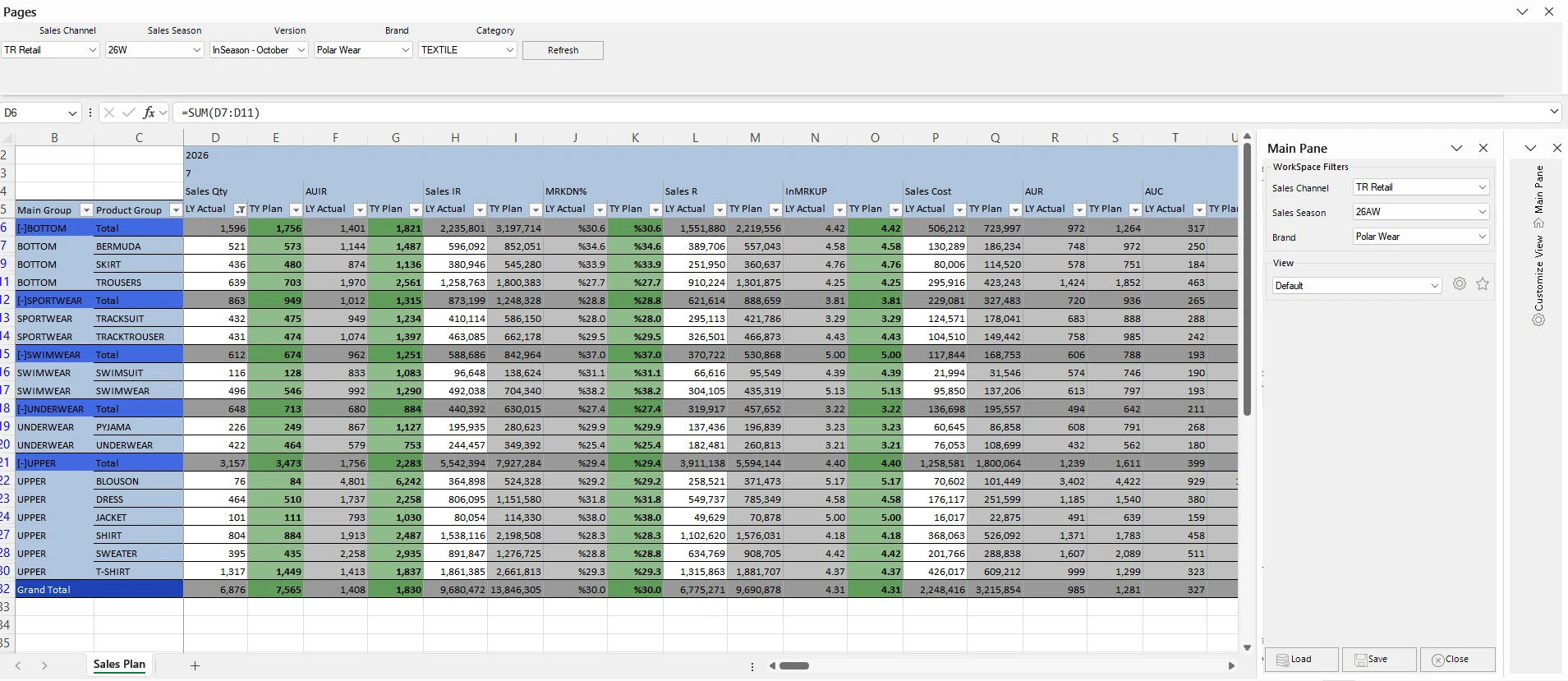
Every screen is built around your planning process. Here is a sales plan workspace from our demo environment.
- Pages filters. Channel, season, version, brand and category from your database.
- Plan entry. Planners type into the green TY plan cells; entries are saved to the server.
- Calculations built in. Formulas are defined when the app is built, so planners only enter values.
- Main Pane. Workspace filters and saved views for each user.
Screen from a QuickApp demo environment; sample data.
Planning features built in
Formula metrics
Metrics are defined with Excel formulas when the application is built, so planners only enter values and the rest is calculated.
Spreading
Enter a total and QuickApp spreads it across the hierarchy by your rules.
Related calculations
Make a calculated field editable. If sales value is units × price, a planner can enter the sales value and QuickApp works back the units.
Locking
Lock values so spreading and edits leave them untouched.
Editable rules
Decide at runtime, with a formula, whether a cell can be edited. For example: not when stock is below a threshold.
Personal layouts
Planners arrange their own views without changing the application.
Procedures
One-click actions in SQL, C# or Python, with parameters: submit for approval, run an allocation, copy a version or export a report.
Extensions
Add your own logic in C# or VB.NET: extended procedures, event hooks, external pools for other data sources and custom editors.
In-app help
Write help for every application. Planners press F1 on a field or value to open it and navigate from there.
Ask Claude or ChatGPT about your live plans and approve the changes they prepare, with your permissions in place.
See how a planning app is built
Step-by-step videos from the QuickApp team: from connecting a database to a working sales budget screen.
Move your planning models to QuickApp
In 30 minutes we map your current planning process and discuss a practical first scope.
Download the QuickApp platform brochure (PDF) →