
How to Run an In-Season Merchandise Plan Review That Leads to Action

In-season review meetings can easily turn into a sequence of reports. Sales, margin, stock and intake are discussed, and everyone leaves with more information. Yet it may still be unclear what should be decided, who will act and when the result will be reviewed.
The problem is not the reports themselves. A sound assessment is impossible without them. The problem is failing to bring the findings of different teams into one commercial view—and then failing to turn that view into action.
Another common mistake is treating the plan as the single source of truth. A plan reflects the assumptions about demand, pricing, product, supply and market conditions that were made when it was built. As the season develops, some of those assumptions will no longer hold. An in-season review should therefore go beyond “Where are we against plan?” and ask:
- Where are we versus last year and the latest forecast?
- What are the market and our competitors telling us?
- Is the gap caused by the original assumptions, execution or changing conditions?
- What should we revise based on what we know now?
There is no perfect plan. What matters is how well you revise it.
Start with a shared assessment
A well-run weekly trading meeting is not a session in which each report is read out in turn. Every function arrives prepared and brings a different view of the same commercial situation.
- Planning presents the outlook for sales, margin, stock, intake, OTB and forecast.
- Buying assesses product, supplier, order and delivery risks.
- Visual merchandising contributes observations about product presentation, space and visibility.
- Marketing brings campaign results, customer response and upcoming communication plans.
- Store operations provides field feedback, execution issues and differences between locations.
With planning acting as the moderator, dashboards, reports and field observations are considered together. The objective is not for one function to impose its data on another. It is to build a shared understanding of what is happening and why.
For example, a sales gap may initially suggest weak product demand. Buying may identify a delivery delay, store operations may show that the product lacks visibility in certain locations, and marketing may report that the campaign did not generate the expected traffic. The appropriate action becomes clearer only when these findings are considered together.
One process, two levels of decision-making
In-season management operates at two levels. Mixing them either pulls the trading meeting into unnecessary detail or leaves decisions too broad to be useful.
Cross-functional trading review
The trading meeting addresses the broader issues: category and channel performance, store clusters, campaigns and overall stock risk. The decisions usually require coordination across functions, such as:
- identifying priority categories or risk areas;
- changing a campaign, visual execution or store operation;
- coordinating stock transfers or managing intake risk; and
- assigning subjects that need deeper planner–buyer analysis.
Not every topic needs an immediate decision in the meeting. Sometimes the right outcome is a clearly defined analysis task, with an owner and a deadline.
Planner–buyer product-group review
Planners and buyers then examine the product groups within their own areas of responsibility. Alongside sales and margin, they review sell-through, stock cover, stock distribution by store and channel, open orders, delivery dates, OTB and end-of-season risk.
Decisions at this level might include:
- reducing, deferring, accelerating or redirecting an order;
- transferring stock between stores or channels;
- revising the forecast and OTB;
- changing price or markdown timing; and
- protecting availability for products or locations that are performing well.
The trading meeting identifies where attention is needed. The planner–buyer review investigates the cause and turns it into an executable decision. Material findings from that detailed work should then feed back into the next trading meeting.
One comparison is not enough
The plan is an important reference, but it is not sufficient on its own. Experienced teams look through at least four lenses:
- Plan: Which targets and assumptions are we moving away from?
- Last year: What do the direction of travel and the comparison base tell us?
- Latest forecast: Has anything changed since our most recent view?
- Market and competitors: Is the issue specific to us, or part of a wider movement?
These comparisons can tell different stories. A category may be behind plan but ahead of last year and the market. In that case, the original plan may have been too optimistic. The reverse is also possible: the plan may be achieved while the market and competitors are growing faster, making the result weaker than it first appears.
Competitor information will not always be complete. Pricing, promotions, availability, new-product activity and store observations can still provide useful direction. The important discipline is not to present an observation as a confirmed fact, and to record the assumptions behind the decision.
For a broader view of the role of the plan, see Empower Your Retail Success with Merchandise Planning.
From assessment to action: five steps
1. Describe the signal precisely
“Sales are weak” is not a useful assessment. State which metric changed, where it changed, how long the movement has continued and which comparison makes it significant.
For example:
Category sales have been 8% below plan for three weeks. Most of the gap comes from the small-store cluster, while online and large stores remain ahead of last year.
This statement directs the team to the right area. It also reduces the risk of applying a category-wide response to a local problem.
2. Separate the commercial drivers
Sales value can move because of units, average selling price, markdown, product mix, store mix or channel mix. Margin can improve while sales decline; sales can grow while margin quality deteriorates.
Start by separating the likely drivers:
- Is demand weak, or was the product unavailable in the right place and at the right time?
- Were sales achieved at full price or through heavier discounting?
- Are a small number of products, stores or channels driving the total?
- Did the change follow a campaign, delivery or allocation decision?
Automatically responding to a sales gap with more stock or a broader markdown can make the problem worse. The action should follow the tested cause, not the first visible metric.
3. Read stock, intake and OTB together
Stock is not inherently high or low. Its meaning depends on the rate of sale, the remaining weeks in the season and where the stock is located. A position that looks manageable today may become a risk once goods in transit and open orders are included.
Review current stock alongside:
- sell-through and stock cover;
- projected end-of-season stock;
- goods in transit and confirmed orders;
- orders that can still be reduced, deferred or redirected; and
- remaining OTB and the flexibility to make new commitments.
The central question is: if the current sales trend continues and planned intake arrives, what stock and margin position will we reach at the next decision point and at the end of the season?
For more on stock policy and control, see What Is Inventory Management?.
4. Choose the right level for action
A category-level issue may be concentrated in a few stores, channels or options. A category-wide markdown or order reduction can then damage the parts of the business that are performing well.
At the other extreme, a short-term movement in a very narrow product-store combination may not be reliable enough to support a decision. The right level is the lowest one at which the evidence is sufficient, the financial effect is material and an operational intervention is possible.
The purpose of drilling down is not to create more analysis. It is to find the cause at a level where the business can act.
5. Make the decision traceable
At a minimum, every decision should record:
- the signal and current diagnosis;
- the agreed action;
- the responsible person or function;
- the expected effect or metric to monitor; and
- the completion and review dates.
If the diagnosis is uncertain, record it as a hypothesis. Checking whether the expected effect occurred at the next review helps the team improve the quality of its decisions over time.
Reading the signal: a few examples
| Signal | Possible interpretation | What to test first | Potential action |
|---|---|---|---|
| Behind plan, ahead of last year and the market | The original plan may have been too optimistic | Growth, price and demand assumptions in the plan | Update the forecast and end-of-season expectation |
| Ahead of plan, behind the market or competitors | The plan is being met, but relative performance may be weakening | Competitor price, promotion, product and availability | Revise price, product, allocation or communication according to the cause |
| Sales below plan, margin above plan | Full-price discipline is healthy, but units or availability may be weak | Where the gap is concentrated by product, store or channel | Use a local stock, forecast or visibility action instead of a broad markdown |
| Sell-through low, future intake high | Overstock risk may be increasing | How much of the order can still be changed and the end-of-season projection | Reduce, defer or redirect orders |
| Total stock adequate, location performance uneven | Stock may be in the wrong places | Lost-sales opportunity in strong locations versus transfer cost | Transfer stock or change allocation where the economics support it |
This table is not a decision rule. The same signal can have different causes; it simply helps identify the first question to test.
Example: one category, three decisions
Consider a category that is behind its sales plan but ahead of its margin-rate target. Looking only at the total, a broad markdown might appear to be the obvious response. A detailed review may show that:
- full-price sales remain healthy online and in large stores;
- excess stock is concentrated in a group of small stores;
- part of the future intake can still be changed; and
- the category total hides both availability risk in strong locations and overstock in weaker ones.
Instead of one general response, three separate actions are needed:
- Transfer an economically sensible quantity from weaker to stronger locations.
- Reduce or redirect the flexible portion of future intake.
- Update the category forecast without applying a general markdown to locations that are selling well at full price.
The difference an experienced planning team makes is not producing more reports. It is being able to separate the different commercial conditions hidden inside the same total.
What should leave the meeting
Decisions do not need to disappear into long meeting notes. One row per decision is usually enough:
| Signal | Diagnosis | Action | Owner | Metric to monitor | Completion | Review |
|---|---|---|---|---|---|---|
| Sales below plan; excess stock in Store Cluster C | Distribution issue, not category-wide demand weakness | Confirm transfer quantity and redirect flexible intake | Planner and buyer | Stock cover and full-price sell-through in Cluster C | Friday | Next trading meeting |
For a cross-functional decision, include the teams involved. If the evidence is not sufficient, do not force the subject into an action. Record it as an analysis task with a clear owner and due date.
Before the meeting closes, the team should be able to answer six questions:
- What changed, and where is the change concentrated?
- What story do plan, last year, latest forecast and market tell together?
- What is the strongest explanation—or the hypothesis that still needs testing?
- How do stock, orders, intake and OTB change the future risk?
- At what level will the business act, and what will it do?
- Who owns the action, and when will the result be reviewed?
Success is not preserving the original plan unchanged. It is recognising changing conditions early enough to turn the plan into a better commercial decision.
How QuickApp supports the process
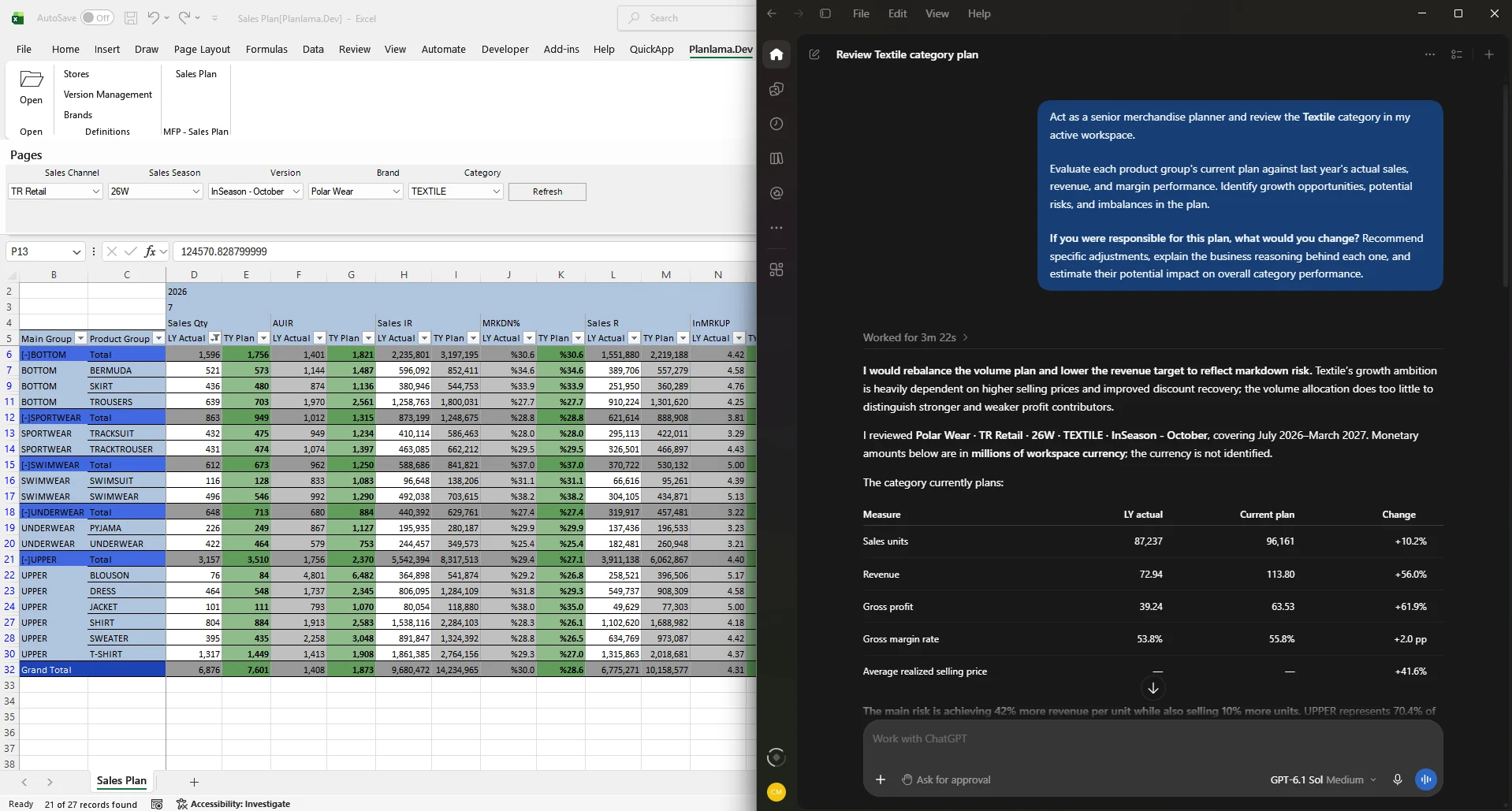
QuickApp brings plan, actual and scenario information for sales, margin, stock and intake into a governed planning environment while allowing users to continue working through Excel. Teams can examine a variance at the level where it occurs, evaluate the effect of alternative actions and manage the revised plan using the same data and rules.
Technology does not replace the commercial decision. A good planning system should shorten the path from assessment to scenario and accountable action.
More articles

See QuickApp with your own plans
A 30-minute session with our consultants, built around your planning process.